Mugwort Oil Myths: Five Stories and What Holds Up
Mugwort has been around so long that it has gathered stories the way an old stone wall gathers moss. Some of them are lovely, a few are shaky, and one or two could send a maker in the wrong direction. Here are five that circulate most, and what the sources actually say about each.

Mugwort Essential Oil
Our own Mugwort Essential Oil, in sizes from 0.5 oz to bulk.
From $16.99
Shop Now →"Oil, tea and tincture are the same plant, so they behave the same"
Same plant, different materials. A cup of tea is a water infusion of the dried herb, a tincture is an alcohol extract, and an essential oil is the volatile fraction pulled out by steam, which makes it a concentrate of the aroma compounds and little else. What was learned about one does not carry over to another. The skin-cell research that often gets quoted for mugwort, for example, used a spray-dried hot-water extract of Artemisia princeps on cultured keratinocytes, not an oil (Hirano et al., 2017). A recent review of Artemisia argyi oil makes a similar point from the other side: most of the evidence is from cells and animals, with few human trials (Gao and Lu). If you are curious how oil and tincture differ at the perfumer's bench, we compared them in mugwort tincture vs essential oil.
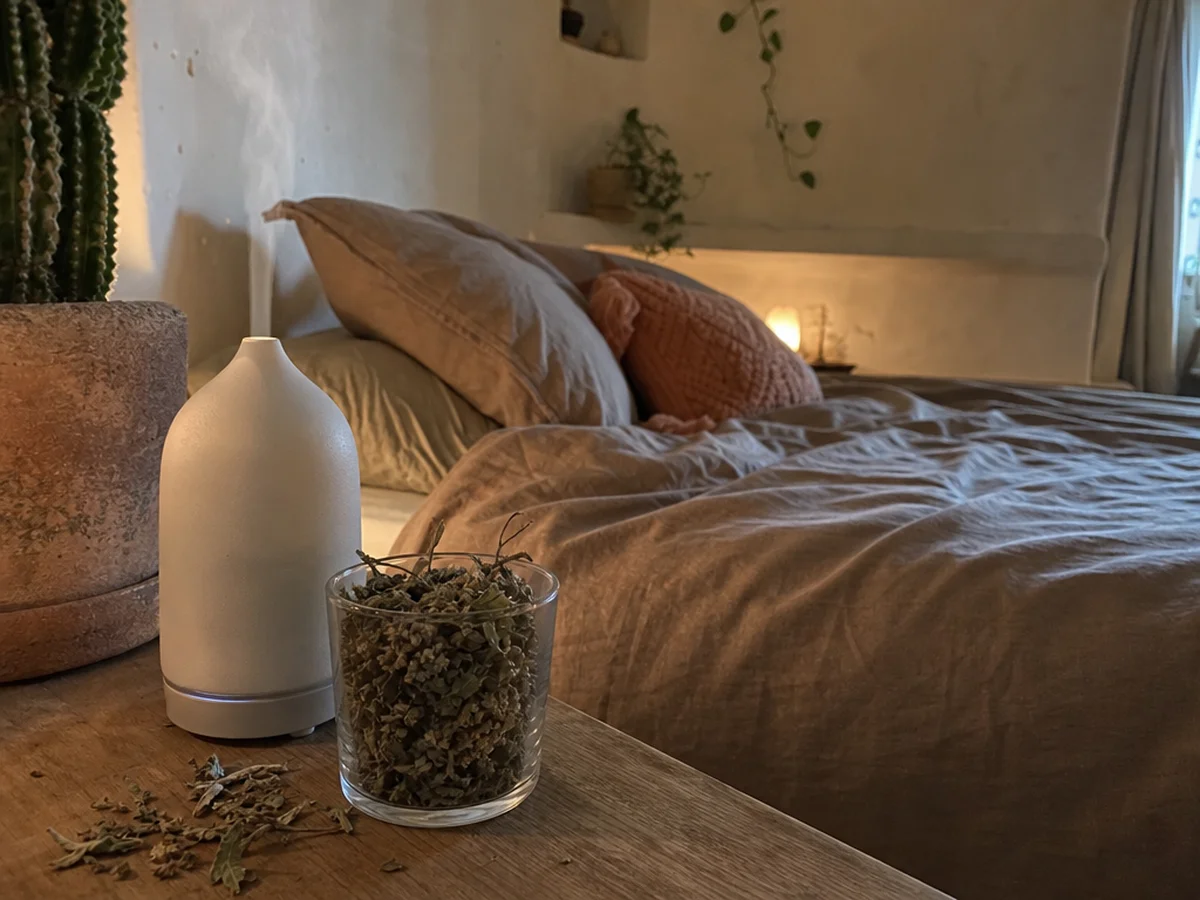
"Diffuse it at night and your dreams will be vivid"
Mugwort's dream reputation is centuries old, and it is a charming piece of folklore. As evidence, it is thin. A 2024 narrative review of substances proposed to induce lucid dreams mentions mugwort as an herb traditionally used to intensify dreams, floats a possible mechanism as a hypothesis, and describes no trial of mugwort. Its authors conclude that more research is needed (Oldoni et al., 2024). Nothing in it concerns an oil in a diffuser, and we sell ours as a fragrance-craft material, not a sleep product. The dream pillow is a nice piece of history to enjoy as exactly that, and our diffuser article covers the practical side.
"All mugwort oils are basically the same"
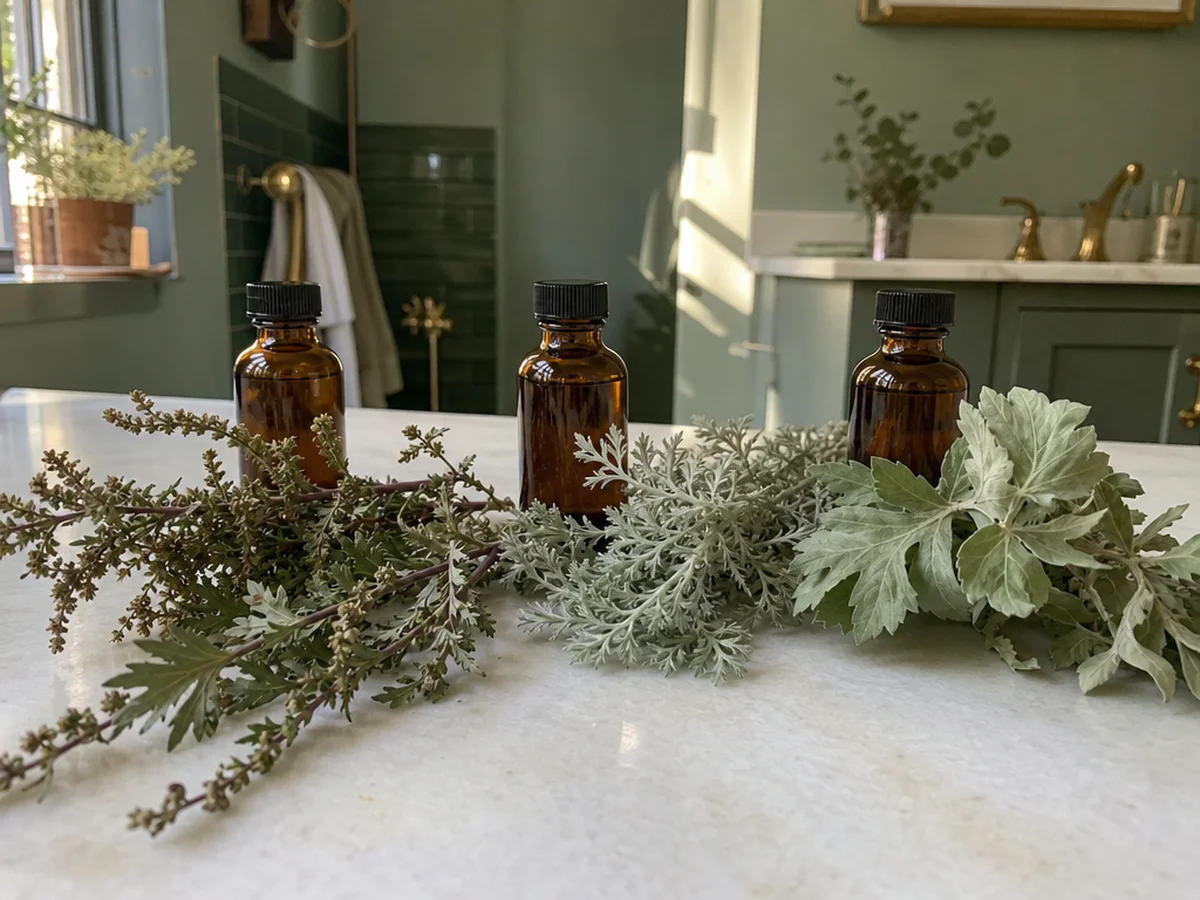
This is the one that surprises people most. Published analyses of oils sold or studied as mugwort read like different ingredients. A hydrodistilled leaf oil of Artemisia argyi from Qichun, China, carried alpha-thujone at about 8% and beta-thujone at about 2% (Guan et al., 2019). A cultivated Artemisia vulgaris oil from Brazil was led by caryophyllene at 37% and listed no thujone (Malik et al., 2019). A third oil was led by cineole and did not mention thujone at all (Li et al.). Species, growing conditions and the way the oil is extracted all move the profile, so "mugwort oil" on a label is a starting point rather than a recipe. Our composition article lays the published analyses side by side, and reading a mugwort oil label explains what to look for.
"If it comes from a plant, it is gentle"
Plants make some powerful chemistry, and thujone is a good example. It turns up in sage, tansy, thyme, rosemary and cedar leaf as well as in wormwood and some mugwort oils. The European Medicines Agency's herbal committee records severe poisonings in people after they swallowed thujone-rich essential oil, and recommends that exposure be kept to a minimum for pregnant women and children, for whom no studies exist (Public statement on the use of herbal medicinal products containing thujone). Those are statements about swallowing, which we never suggest. For fragrance, the industry's own rulebook caps thujone by product type, from 0.095% in body oils and lotions up to 9.5% in candles and incense (IFRA, 51st Amendment Standards compilation, Thujone Standard). That spread is a neat clue to where mugwort oil belongs: it is a craft oil, comfortable in a candle or an incense blend. For skin, our guidance is a dilution of 0.5% to 2% in a carrier with a patch test, and we would start at the low end. We keep it away from children, pets and pregnancy, and it is never for internal use. More in mugwort oil safety.
"Korean skincare proves mugwort oil is a skin ingredient"
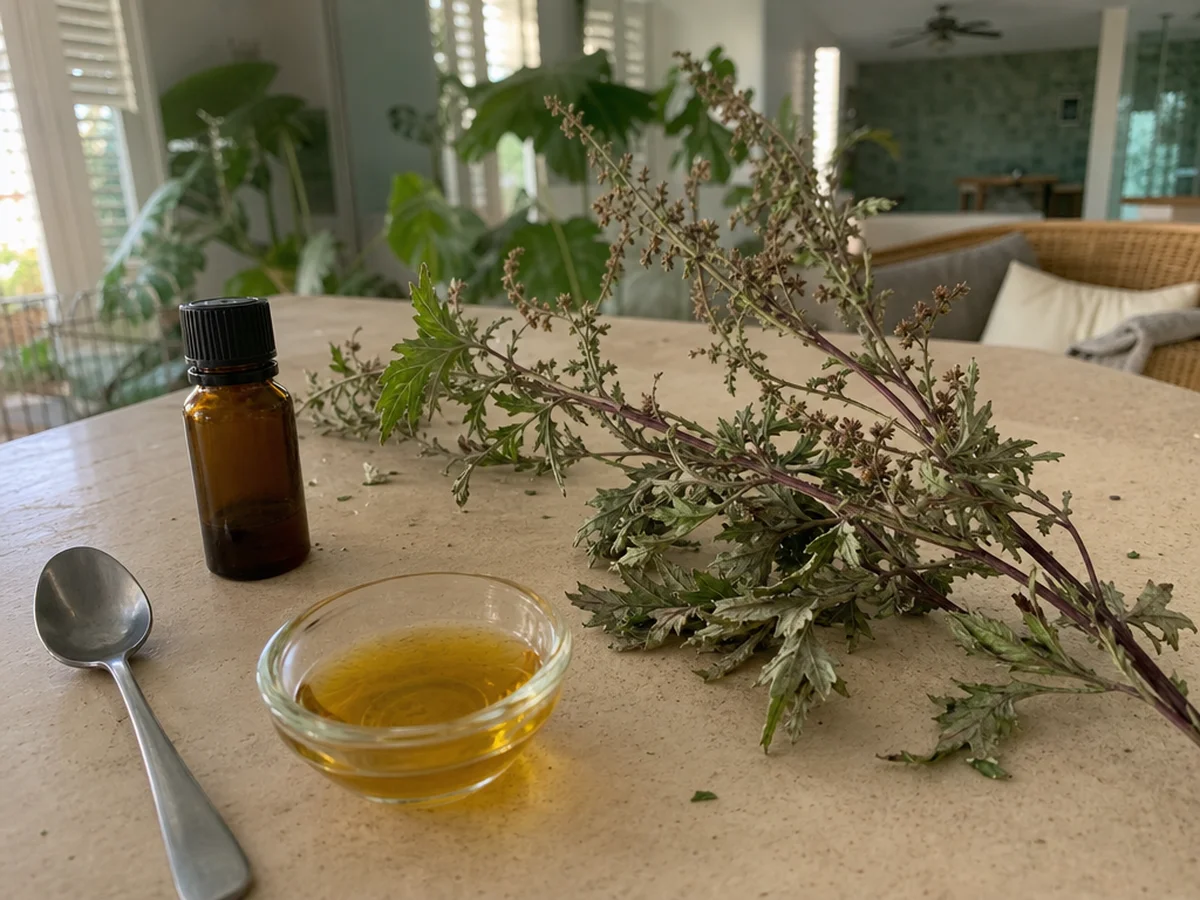
Mugwort's popularity in K-beauty is real, but what the studies handle is an extract, usually in water, at fractions of a percent. The Hirano work used 0.01% and 0.03% of the extract on cells and saw cell viability fall above 0.3%. That is a lovely piece of laboratory work on a different material, and it says very little about a drop of essential oil. We offer our oil for fragrance craft, and the K-beauty article goes into why the two get mixed up.
A better way to get to know it
Your nose is a wonderful tool, but it works best alongside paperwork rather than instead of it. A green, bitter, camphoraceous smell tells you how the oil strikes you today; it does not tell you which plant is in the bottle. Smell it, enjoy it, write down what you notice, and keep the label and batch documents beside your notes.
What holds up
The kernel of truth under all five is that mugwort is a distinctive, characterful plant with a long human history. We describe the aroma as green, bitter and camphoraceous, with sage-like, herbaceous facets and a curious sweet undertone, and that is reason enough to enjoy it. Treat it as a bold, concentrated fragrance material, smell before you commit, and if you need a specific figure for a formulation, write to us through the contact page and ask.
Mugwort Essential Oil
Mugwort Essential Oil from our own shop, in sizes from 0.5 oz to bulk.
From $16.99
Shop Now →Sources & Further Reading
- Hirano A, et al. 2017. Antioxidant Artemisia princeps Extract Enhances the Expression of Filaggrin and Loricrin via the AHR/OVOL1 Pathway. PMC5618597
- Gao Q, Lu Y. Pharmacological and bioactive properties of Artemisia argyi H. Lév. & Vaniot essential oil: a review. PMC12820526
- Oldoni AA, et al. 2024. Neuropsychopharmacological Induction of (Lucid) Dreams: A Narrative Review. PMC11119155
- Guan X, et al. 2019. Chemical Composition and Antimicrobial Activities of Artemisia argyi Lévl. et Vant Essential Oils Extracted by Simultaneous Distillation-Extraction, Subcritical Extraction and Hydrodistillation. PMC6384757
- Malik S, et al. 2019. Chemical Profile and Biological Activities of Essential Oil from Artemisia vulgaris L. Cultivated in Brazil. PMC6631396
- Li D, et al. The antimicrobial effect and mechanism of the Artemisia argyi essential oil against bacteria and fungus. PMC10920523
- European Medicines Agency, HMPC. Public statement on the use of herbal medicinal products containing thujone (EMA/HMPC/732886/2010 Rev. 1). ema.europa.eu
- IFRA. 51st Amendment Standards compilation, Thujone Standard. IFRA Standards