When Is Mugwort Best Cut? What Harvest Trials Say
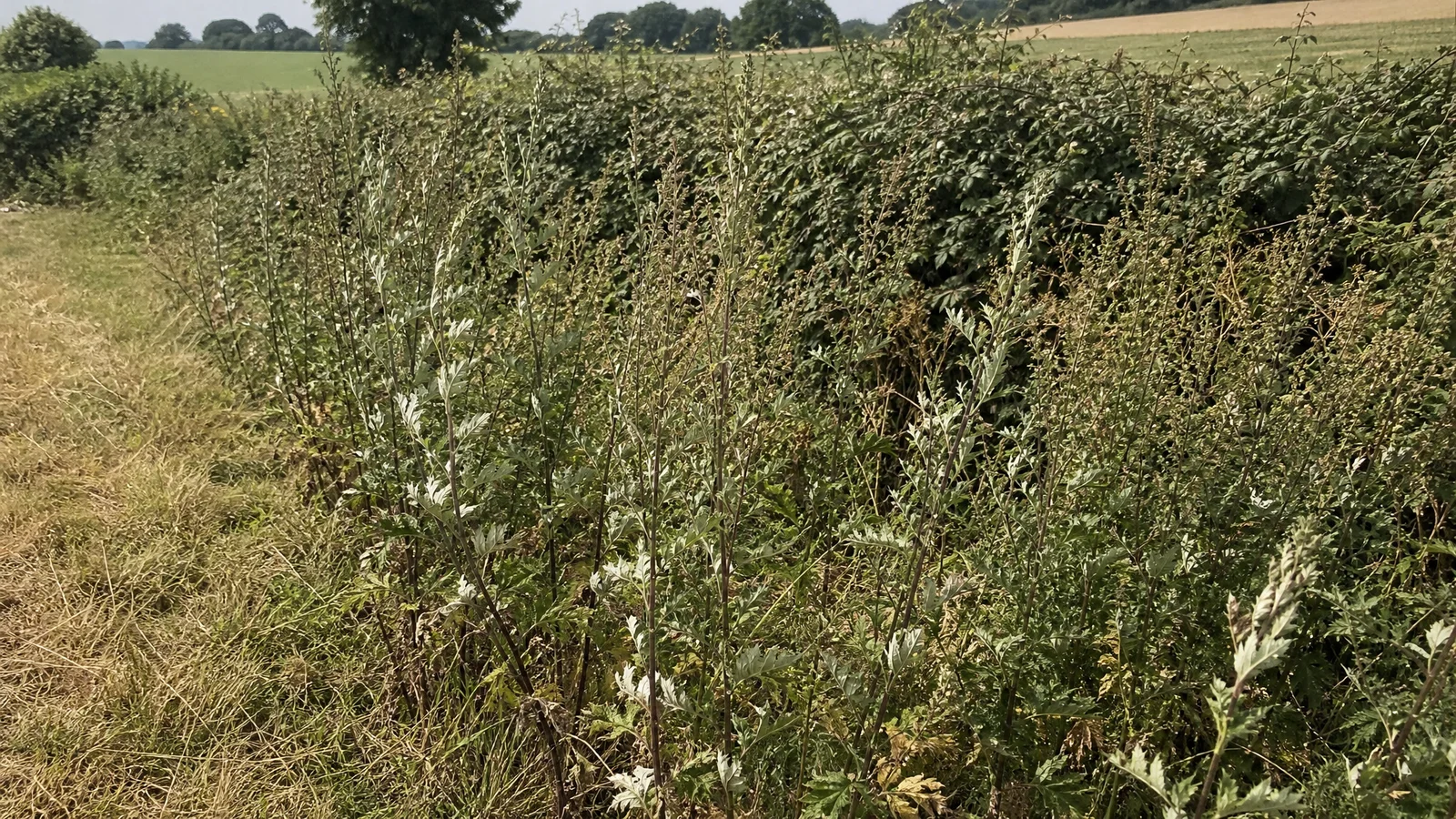
Walk a field edge in September and mugwort is easy to spot: tall, silver-backed leaves, long plumes of small flowers. It is natural to link the plant with autumn, and to imagine the oil as a moody, late-season scent. The research is more interesting than that, because the best-documented harvest window for mugwort is not autumn at all. It is early summer.

Mugwort Essential Oil
Our own Mugwort Essential Oil, in sizes from 0.5 oz to bulk.
From $16.99
Shop Now →What a harvest trial found
A field trial of Artemisia argyi, a Chinese mugwort, in Nanyang, Henan, planted seedlings on 29 March and cut them on five dates, from 6 June to 8 July. The leaves were tested for volatile oil, and the lowest value came on 6 June in every planting density. The highest came on 30 June at three densities and on 8 July at the fourth, so oil content rose through the window and then eased slightly. The authors conclude that cutting about a week after the Dragon Boat Festival gave the best overall quality, and note that eucalyptol and borneol followed the same up-and-down pattern (He et al., 2026). They also cite earlier studies that put the peak around the festival or as early as 20 May, and one that found little difference between cutting dates. So even careful researchers disagree about the exact week.
The Dragon Boat Festival, on the fifth day of the fifth lunar month, has a pleasing link to folklore. James Frazer quotes an old Chinese calendar saying that on that day people pluck mugwort and hang dolls of it over their gates and doors (The Golden Bough, volume 11). Our folk magic article follows that thread across Europe.
Stage and place change the oil
For another look at timing, an Italian study cut wormwood, a related Artemisia, at the vegetative stage and at flowering at two sites. Yields and chemistry shifted with both: at one site the flowering oil, collected in July, was about 51% monoterpene hydrocarbons, while the May vegetative oil was led by oxygenated sesquiterpenes (Malaspina et al., 2025). Wormwood is a different plant, so this does not tell us which way mugwort moves. It does show that growth stage and site can change what a still produces.
What happens after the cut counts too. Three cultivars of A. argyi dried in different ways gave oil yields from 0.37% to 1.08%, with hot-air drying at 80 degrees C at the bottom and shade drying of undefoliated plants at the top (Ming et al., 2025). Real oils show a wide spread: a Serbian common mugwort cut in flower and shade-dried gave 0.012% by steam distillation (Tojić et al., 2025), while Brazilian leaves dried at 40 degrees C gave 0.5% (Malik et al., 2019). Those two cannot be compared directly, because one used whole aerial parts and the other leaves, and the Brazilian plants were cut in August, before flowering. “Autumn” is a calendar word; for the plant, growth stage, climate and hemisphere are what count.
One timing fact is well established. In New York, mugwort flowers from July to late September (New York Invasive Species Information, Mugwort), so an autumn cut there would normally mean flowering or seed-set plants. We found no study of what that does to the oil.
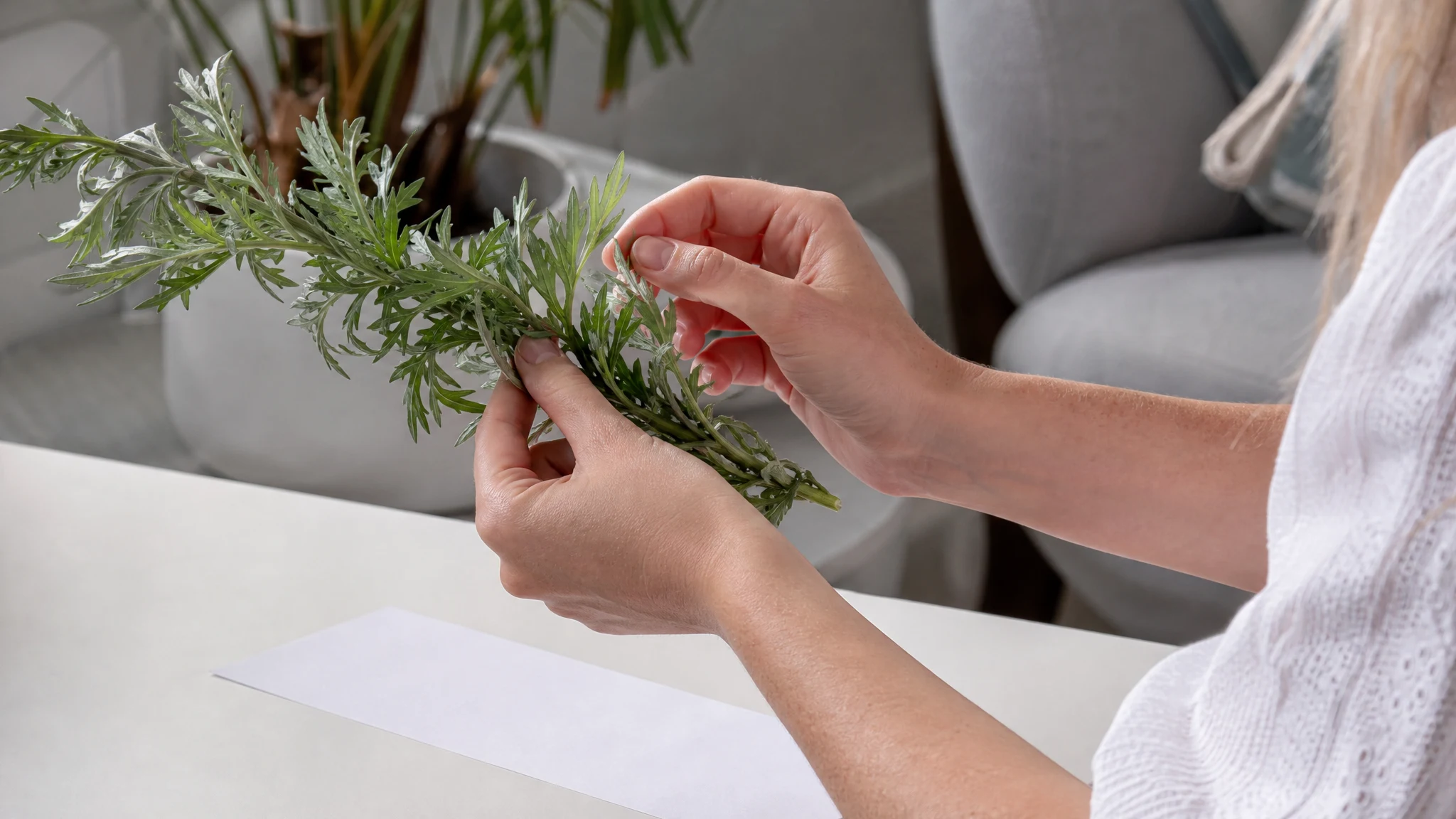
If you grow or forage mugwort yourself, the plant gives you a few simple cues without a laboratory. Rub a leaf between your fingers on a warm morning and smell it. The scent is greener and sharper in some weeks than in others, and a note of the date next to a pressed leaf in a notebook will teach you more about your own patch than any chart. Make sure you know your plant first, since mugwort has look-alikes, and the plant guide can help you tell them apart.
What this means when you shop
We would treat any seasonal claim on a mugwort oil label as a question to ask the supplier, not a mark of quality. The useful questions are which species and plant part was distilled, when it was cut, how it was dried, and whether the lot has a composition analysis. If you have questions about ours, ask in writing through our contact page and rely on the reply once you have it in writing. Our label-reading article covers species and origin wording, and the composition article lays published analyses side by side.
An autumn scent, on your terms
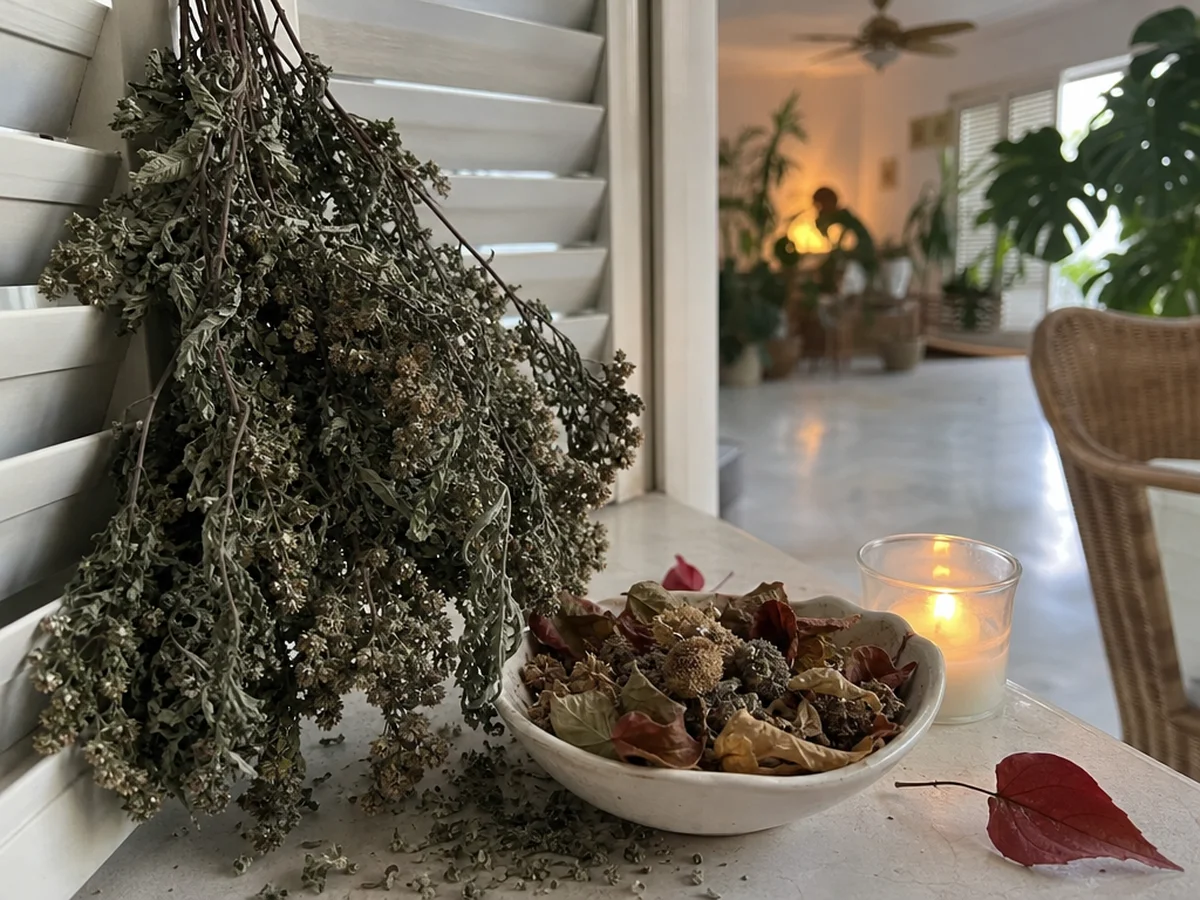
The season you can control is in the blend. We list cedarwood, clary sage, juniper, frankincense and cypress as partners for our mugwort oil, and woods and resins are the obvious reach for an autumn mood: dry leaves, smoke, damp earth. We sell only the mugwort, so the partners come from a craft or perfumery supplier. Because mugwort oils can carry thujone, which has a published ceiling in finished products, keep mugwort the smallest voice in the blend; the pairing guide works through the numbers. For particular formats, see the potpourri mixes, candle structures and room spray formula. For burning anything dried, burning mugwort indoors reports what air studies measured. Our shop guidance is to keep the oil away from children and pets and to avoid it in pregnancy.
If you want a little of the season on a shelf, try gathering a few dry seed heads and stems in autumn for a vase. They keep their shape well and give off a faint green scent, and they remind you that the plant looks quite different in October from the way it looked in June.
Enjoy mugwort in October by all means; just know that the best-studied time to cut it is in the early summer sun.
Mugwort Essential Oil
Mugwort Essential Oil from our own shop, in sizes from 0.5 oz to bulk.
From $16.99
Shop Now →Sources & Further Reading
- He H et al., 2026. Effect of planting density and harvesting date on yield and quality of Artemisia argyi. PeerJ. PMC12810393
- Malaspina P et al., 2025. Exploring Chemical Variability in the Essential Oil of Artemisia absinthium L. in Relation to Different Phenological Stages and Geographical Location. Chemistry & Biodiversity. PMC12533806
- Ming J et al., 2025. Effects of drying methods on phenolic acids, flavonoids, and essential oils in three cultivars of Artemisia Argyi. Food Chemistry: X. PMC12721075
- Tojić T et al., 2025. Allelopathic Potential of Artemisia absinthium and Artemisia vulgaris from Serbia: Chemical Composition and Bioactivity on Weeds. Plants. PMC12158117
- Malik S et al., 2019. Chemical Profile and Biological Activities of Essential Oil from Artemisia vulgaris L. Cultivated in Brazil. Pharmaceuticals. PMC6631396
- New York Invasive Species Information. Mugwort - NYIS. nyis.info
- Frazer JG, 1913. The Golden Bough: A Study in Magic and Religion (Third Edition, Vol. 11 of 12). Project Gutenberg. gutenberg.org